At Tutorwaves, we believe that learning goes beyond traditional academics. We understand the importance of nurturing the whole student, so we encourage exploring diverse skills, such as music. One such area where students can significantly benefit is Carnatic music, a classical music tradition from South India.
We aim to position ourselves as experts not just in academics but also in developing well-rounded students. Our approach to learning emphasizes a holistic education, where arts and music, including Carnatic music, play a key role in shaping students’ cognitive and emotional growth. By incorporating music into their routine, students not only explore creativity but also build skills that help them excel in academics and other areas of life.
By focusing on “learning by the student,” we encourage students to engage deeply with the material, whether it’s through math, science, or even music. Whether they are looking to improve their grades or engage with their culture, Carnatic music can be a valuable part of their journey toward success. At Tutorwaves, we are committed to fostering an environment where students are encouraged to discover and develop their full potential through a combination of academic excellence and artistic expression.
What is Carnatic Music?
Carnatic music, one of the oldest and most refined forms of classical music in the world, stands as a unique and profound tradition that not only captivates listeners with its complexity and beauty but also offers a wealth of cognitive and mental benefits. Rooted in the southern part of India, Carnatic music is more than just an art form; it is a discipline that has been passed down through generations, shaping minds and spirits along the way. In addition to its cultural and emotional richness, Carnatic music has long been known to promote discipline, enhance mental agility, and foster a deeper connection between mind and body.
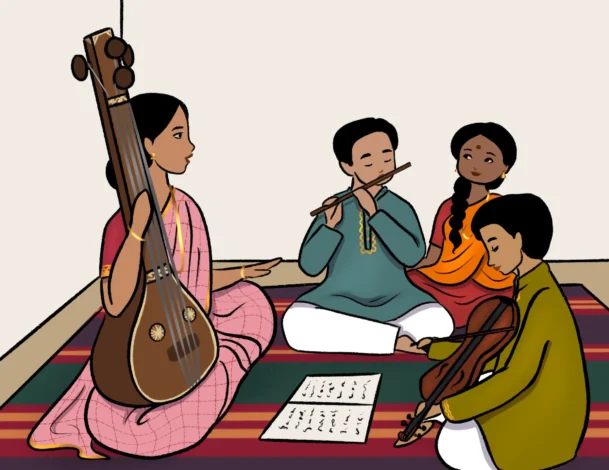
Carnatic music is a classical music tradition that is based on two key components: ragas (melodic scales) and talas (rhythmic cycles). It is deeply rooted in spirituality, often focusing on devotional themes, and has been the backbone of many cultural and religious ceremonies in South India for centuries. Unlike Western classical music, which often centers around orchestral arrangements, Carnatic music typically features solo vocal performances or smaller ensemble compositions accompanied by instruments like the violin, mridangam (a traditional drum), flute, and veena (a string instrument).
Carnatic music compositions are highly intricate, demanding not just technical skill but also emotional engagement. It is a living, evolving tradition, with a wide array of ragas and talas that allow performers to innovate and explore, all while adhering to a structured set of rules and guidelines.
The Role of Ragas and Talas in Shaping Discipline
At the heart of Carnatic music lies the concept of raga and tala. These two elements dictate the foundation of any performance. Ragas are unique combinations of notes that evoke distinct emotional moods or feelings. Talas are the rhythmic cycles that provide the structure within which the raga is played. The mastery of both ragas and talas requires immense focus, patience, and repetition.
Discipline in Practice and Performance
Learning Carnatic music requires years of training and practice. Aspiring musicians often begin their education at a very young age, and their journey involves a systematic approach to understanding ragas and talas. Each raga has its own set of rules regarding the ascending and descending notes, as well as specific time and mood associations. Similarly, each tala has its pattern of beats, which musicians must memorize and internalize to ensure accurate performance.
The commitment to understanding these concepts and the hours of practice needed to perfect them cultivate an unwavering discipline. A Carnatic musician’s ability to practice scales, intricate rhythms, and compositions for extended periods sharpens both their physical and mental faculties. The training enhances one’s ability to focus, stay committed, and persevere in the face of challenges, providing a strong foundation for personal development.
Enhancing Mental Agility Through Improvisation
One of the defining features of Carnatic music is its emphasis on improvisation. Unlike Western classical music, where compositions are often played exactly as written, Carnatic musicians are encouraged to improvise within the structure of the raga and tala. This element of improvisation challenges musicians to think on their feet, push their creative boundaries, and respond to the music in real time.
Improvisation sharpens mental agility, as the musician must quickly adapt to changes in rhythm, melody, and timing, all while maintaining coherence within the framework of the composition. It is this mental flexibility that makes Carnatic music not just a technical pursuit but also an intellectual exercise. Musicians must develop strong cognitive skills such as problem-solving, quick thinking, and spatial reasoning as they navigate complex musical passages.
The Cognitive Benefits of Carnatic Music
Numerous studies have shown the positive impact of music on the brain. Carnatic music, in particular, offers a myriad of cognitive benefits. Research suggests that learning and playing complex music like Carnatic compositions can enhance memory, improve concentration, and stimulate creativity.
The mental workout involved in mastering a Carnatic piece requires the musician to engage multiple areas of the brain. The combination of auditory processing, motor skills (in the case of instrumentalists), and memory retention develops stronger neural connections, boosting cognitive function. Furthermore, the structured nature of Carnatic music, with its precise timings and interwoven melodies, also improves one’s ability to focus and multitask.
In addition, the discipline and dedication required for mastering Carnatic music help to increase self-control, patience, and perseverance. These qualities extend beyond the musical sphere and can positively influence other areas of life, from academic pursuits to professional work.
Emotional and Spiritual Growth
Carnatic music is also renowned for its emotional and spiritual depth. Many of its compositions are devoted to expressing devotion to deities or exploring themes of love, compassion, and introspection. The ability to perform music that is so emotionally charged and spiritually resonant requires the artist to be deeply in tune with their inner emotions and to express them through their instruments or voice.
This emotional engagement, combined with intellectual stimulation, leads to a holistic form of growth. Musicians often describe the act of performing Carnatic music as a form of meditation. The focus on precise techniques, along with the transcendental experience of connecting with the music, fosters mindfulness and emotional clarity.
Conclusion
Carnatic music is much more than an art form; it is a pathway to personal growth, intellectual development, and emotional enrichment. Its intricate system of ragas and talas teaches discipline, while the improvisational nature of the tradition fosters mental agility and creativity. As musicians dedicate themselves to perfecting their craft, they also sharpen their focus, problem-solving skills, and emotional resilience.
This rich tradition continues to inspire and challenge musicians and listeners alike, offering a timeless source of personal development. Whether one is a student of Carnatic music or simply an admirer of its beauty, there is no doubt that its ability to foster discipline and mental agility makes it an invaluable pursuit for anyone seeking growth in both the mind and the spirit.