“Will I ever use this?”
It is one of the most common questions students ask while learning mathematics—and one that parents often wonder about too. Many mathematical topics feel abstract, disconnected from daily life, and far removed from real-world use.
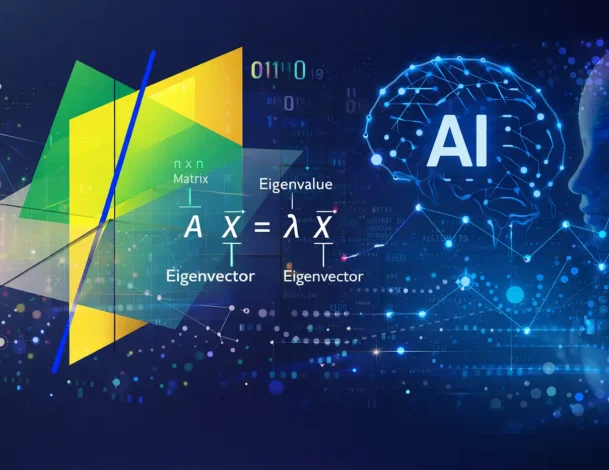
Yet today, some of the most powerful and disruptive technologies—Artificial Intelligence (AI) and Machine Learning—are built directly on those very concepts. At the center of them lies a branch of mathematics students often underestimate: linear algebra.
Understanding this connection changes how we view both mathematics and the future.
AI Is Everywhere—But It Is Not Magic
Artificial Intelligence is already part of everyday life:
- Google anticipates what you are searching for
- YouTube and Netflix recommend videos you might enjoy
- Smartphones unlock by recognizing your face
- Virtual assistants like Siri or Alexa respond to your voice
All of this feels intelligent—but AI does not “think” like humans. It works with data, and lots of it.
To store, organize, compare, and learn from this data efficiently, computers rely on a mathematical framework designed for handling large collections of numbers: linear algebra.
What Does Linear Algebra Actually Do in AI?
Linear algebra is not about solving long equations by hand. It is about representing information in a form machines can learn from.
In AI systems:
- Data is represented as vectors (ordered lists of numbers)
- Images, sound, and text are stored as matrices (tables of numbers)
- Learning happens through repeated transformations of these vectors and matrices
For example:
- A digital image is a matrix of pixel values
- A user profile on a streaming platform becomes a vector of preferences
- A voice command is transformed into numerical patterns
AI models process these representations using linear algebra to detect patterns, compare similarities, and make predictions.
Without linear algebra, modern AI simply cannot function.
Real-World Applications Students See Every Day
Linear algebra may seem abstract in textbooks, but its impact is visible everywhere:
Personalized Recommendations
Recommendation engines compare millions of vectors to find content similar to your interests.
Image and Face Recognition
Facial recognition systems analyze numerical patterns across images to identify individuals.
Voice and Speech Recognition
Speech is converted into numbers and analyzed using mathematical models.
Search Engines
Search rankings are determined by analyzing relationships between massive datasets.
These are not fringe use cases—they are core technologies shaping how we live and work.
Addressing the Big Question: “Will I Ever Use This?”
This is where linear algebra offers a powerful answer.
Many people feel that much of school mathematics has no real application because:
- Its use comes years later
- Technology hides the math behind interfaces
- Concepts are taught without showing where they lead
Linear algebra challenges this perception head-on.
It shows that:
- Math is not obsolete—it is embedded inside modern technology
- School topics are not discarded—they are repurposed at scale
- Understanding concepts matters more than performing manual calculations
Students may not directly write AI algorithms, but they are learning the language in which modern systems operate.
That is real utility—even if it becomes visible only later.
Why Linear Algebra Matters for Students
A strong foundation in linear algebra helps students:
Build Analytical Thinking
Students learn how complex information is structured and transformed.
Prepare for Future Careers
AI, data science, engineering, finance, computer science, and analytics all rely heavily on these ideas.
Learn Advanced Topics with Confidence
Concepts in coding, machine learning, and data analysis become easier to grasp.
See the Purpose of Mathematics
Math stops being “just for exams” and starts making sense as a tool that explains the world.
Do Students Need to Do Advanced Calculations?
No.
Modern tools handle heavy computation. What students truly need is:
- Conceptual clarity
- Logical reasoning
- The ability to interpret and connect ideas
Linear algebra develops mathematical intuition, not just calculation skills. That intuition is what carries forward into higher learning and future technologies.
Linear Algebra: Learning That Grows in Value Over Time
Unlike many topics that feel useful only in the moment, linear algebra gains relevance with age, experience, and exposure to real systems.
It teaches students something deeper:
Mathematics is not about immediate payoff—it is about building frameworks that make future learning possible.
As AI continues to shape industries and careers, students who understand these foundations are better prepared to adapt, innovate, and excel.
Final Note
At TutorWaves, we believe that strong fundamentals turn confusion into clarity. Our expert tutors help students understand mathematics not as isolated formulas, but as ideas that power the real world.
By connecting concepts like linear algebra to real-life applications such as Artificial Intelligence, we empower students to learn with confidence, curiosity, and purpose—preparing them not just for exams, but for the future.